Repair & recovery
Find the fault, then talk money
There are two kinds of repair shop: one swaps parts until the symptom goes away, the other finds the component that failed. The second kind needs a microscope, a schematic and the discipline to quote before working — and that is the bench we run at Motorway Chowk Markaz. Here is the route every machine takes across it.
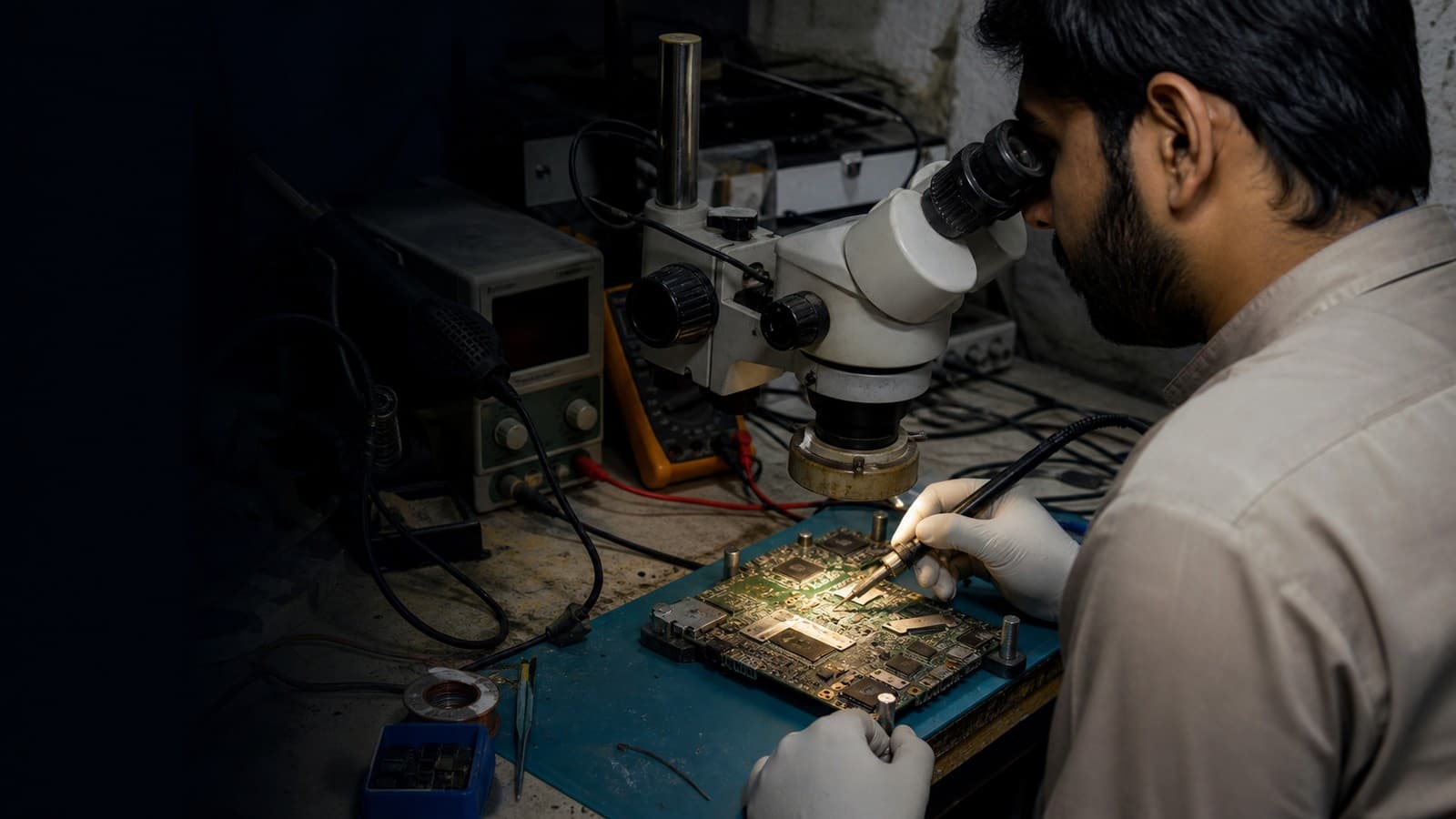
Most dead boards are not dead
Under the microscope, a written-off motherboard is usually one failed component. We replace that component, not the board.
- Free diagnosis
- Fixed price before work
- Failed part shown to you
01
The job card comes before the screwdriver
We start by writing down the story — the spill, the thud, the exact moment the lights came back on — because the story usually points straight at the fault. The job card records the machine's condition, the data policy you are agreeing to and the diagnosis fee. Past diagnosis, nothing happens without your yes.
02
Power rails first
Most machines brought in dead are not dead — they are unpowered. Adapter, DC jack, a fuse, or one shorted component dragging a rail to ground. A multimeter and a bench supply separate the genuinely gone from the merely silent inside fifteen minutes.
03
The board goes under the microscope
Spill corrosion, a bulged capacitor, a scorched charging IC — obvious at magnification, invisible to anyone diagnosing by module swap. This is the whole difference of chip-level work: we hunt the failed component, not the biggest part we could bill for.
04
A ceiling price, before the work
You get the fault named in plain words and a price that is a ceiling, not an opening bid. If we find more once inside, the phone rings before the work continues — never a surprise line on the invoice. And when the machine is not worth its own repair, the quote says that instead.
05
Repair, then burn-in
After the fix comes the punishment: hours under load, video looping, battery cycling, temperatures logged. A repair that has survived a full afternoon on the bench is one we are happy to warranty. Ten quiet minutes prove only that the bench had electricity.
Data recovery: stop pressing the power button
A clicking or grinding drive is injuring itself, and every hopeful power-on drags a damaged head across the very sectors you want back. Switch it off, bring it to us cold, and open with the sentence that reorders our whole process: “the data matters more than the machine.”
Deleted files & formats
Come back more often than people fear — provided the space has not been written over. Stop using the drive the moment you notice; the odds fall with every hour it stays in service.
Failing drives
First imaged sector by sector onto healthy hardware; all recovery work runs on the copy. The original is never the thing being experimented on, and it goes back to you either way.
The honest ceiling
Platters that must be opened need a clean-room lab we do not pretend to be. We say so immediately and help you weigh the lab's real price against what the data is actually worth.
Repair questions
Another shop declared the board dead. Is that final?
Frequently not. Shops that diagnose by swapping modules run out of modules to swap and then pronounce the board dead. Chip-level work happens one layer below that: a shorted capacitor or a failed power IC costs a few hundred rupees once somebody actually finds it under magnification. We look first — and when a board genuinely is beyond saving, we say that plainly too.
Who sees my data while you have the machine?
Nobody. The drive stays in the machine unless the repair physically requires pulling it, and nothing on it is opened or copied. If a repair carries any risk to the data, you hear about it before we start, and we back the drive up first with your permission. That policy is printed on the job card you sign — not a verbal custom.
How long will the repair take?
Screens, keyboards and batteries: usually the same day when the part is on the shelf. Board-level faults: two to four working days, because the repair is followed by hours of burn-in and a board that only ran ten minutes has proved nothing. Data recovery gets no invented deadline — it takes what the drive permits.
And if it cannot be fixed?
You pay the diagnosis fee, the machine comes back assembled, and you get told in plain words what died. When a replacement makes more sense than the repair, we say so — and if you buy the replacement from us, the diagnosis fee comes off its price.