Skip to content
Mon – Sat · 10:00 AM – 9:00 PM

Solar · Islamabad & Rawalpindi

Three IESCO bills decide your solar system. Not your roof.

A quote written before anyone has read your units is a guess dressed as a package. Photograph your last three IESCO bills and send them over: we reply with the size in kilowatts, the installed price in rupees and a payback you can hold us to — before a ladder touches your wall. Surveys are free across Islamabad and Rawalpindi from our H-15 workshop at Motorway Chowk.

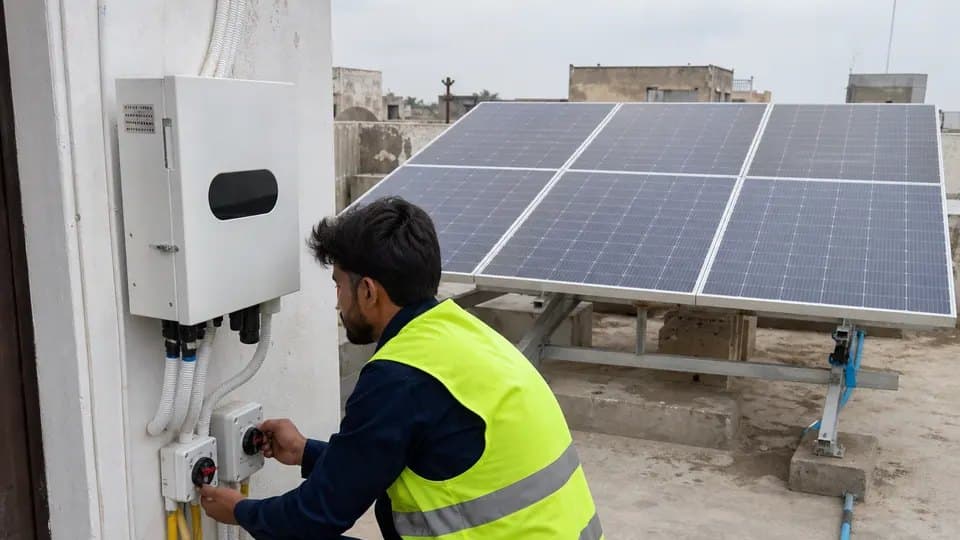
Technician wiring the DC isolators beneath a wall-mounted solar inverter, the roof-mounted panel array behind him

Sized to your bill, not to the roof

We read three months of IESCO bills before quoting a single panel — which usually means a smaller system and a shorter payback.

  • Sized from real usage
  • Net metering handled
  • Payback stated honestly

Pick your problem

One word, three different purchases

A bill problem, an outage problem and a both problem take different equipment. Buying the wrong one is the costliest mistake in solar, because putting it right usually means a new inverter.

Shrink the bill

On-grid system

Panels feed a grid-tied inverter that carries your daytime load and, once net metering is approved, exports the spare units for credit. Lowest cost per kilowatt and the quickest payback of the three.

The moment IESCO drops, so does it. Zero output, full sun.

See the numbers

Ride through outages

Hybrid + battery

A hybrid inverter cuts over to a battery in a blink when the feeder trips, then refills the bank from the panels. Your chosen circuits stay up; the rest wait for the grid like everyone else.

The bank, not the panels, is the big line on this quote.

Watch an outage play out

Both

Hybrid + net metering

What most Islamabad households actually order: backup through the trip-outs, plus export credit on the surplus once IESCO fits the bidirectional meter.

IESCO approval runs in weeks and months, never days.

The approval timeline

Price bands

Installed prices, in the open

On-grid, installed and commissioned, at capital-city rates. A usable battery bank sits on top of these figures — storage is the expensive half of a modern hybrid quote, and we always price it as its own line.

Line-by-line breakdown
  • 2–3 kWPKR 350,000 – 480,000

    Apartment or small house, no heavy AC load

  • 5 kWPKR 550,000 – 750,000

    Family house in the sectors — the common order

  • 10 kWPKR 1,000,000 – 1,400,000

    Large villa, office floor, mart or clinic

Bands come from jobs priced in Islamabad and Rawalpindi this year, not from a brochure. The free survey turns a band into a number.

Honest limits

Four things we will not promise

Run two ACs all night on a battery

It can be engineered, and the bank costs more than the rest of the system. The sane arrangement runs the ACs while the grid is up and keeps the battery for lights, fans, the fridge and the router.

Pay for itself in eighteen months

That arithmetic assumes June sunshine twelve months a year and an inverter that never ages. At capital tariffs the honest window is three to five years — quicker once net metering credits start landing.

Power anything in an outage without a battery

An on-grid inverter must shut down when the feeder dies: it has nothing to synchronise to, and it must not energise a line a lineman may be holding. A seller who skips this sentence is not selling honestly.

Hold rated output without cleaning

Islamabad is kinder than the Potohar dust bowl, but monsoon grime and winter smog still film the glass. Two proper washes a year keep the output curve where the datasheet drew it.

Read before you sign anything

Asked before every solar job

Will solar keep my lights on during load-shedding in Islamabad?

Only a hybrid system with a battery will. A plain on-grid inverter switches itself off within a second of the grid dropping, even under a clear June sky, because it has no live IESCO line to synchronise against. Islamabad outages are shorter than up-country, but a battery-less system still sits dark through every one of them.

How do you decide the system size?

From the units printed on your last three IESCO bills. Average the monthly units and divide by roughly 120: an F-sector house on 650 units lands at 5 kW, a G-11 apartment on 250 units at 2 kW. Any figure produced without seeing a bill is a guess, and guesses tend to run large.

What does a solar system cost in Islamabad?

Installed and commissioned: a small 2–3 kW on-grid system from about PKR 350,000, a 5 kW between PKR 550,000 and 750,000, a 10 kW between PKR 1,000,000 and 1,400,000. Adding a usable battery bank puts PKR 250,000 to 600,000 on top. Honest payback at capital tariffs is three to five years.

Do you handle the IESCO net metering application?

Yes — the full file, submission at your sub-division, the follow-up visits and attendance at the inspection, for PKR 45,000 flat. The chasing is most of the work; applications that nobody asks after are the ones that sit for months.