Point of sale
A counter that knows what it sold
Before a POS, three questions run a mart on estimates: what sold today, what is left on the shelf, and what should be in the drawer. After it, all three have exact answers at closing time. Here is what one complete counter is built from and what each part costs in Islamabad — so you can hold any quotation against this list, ours included.
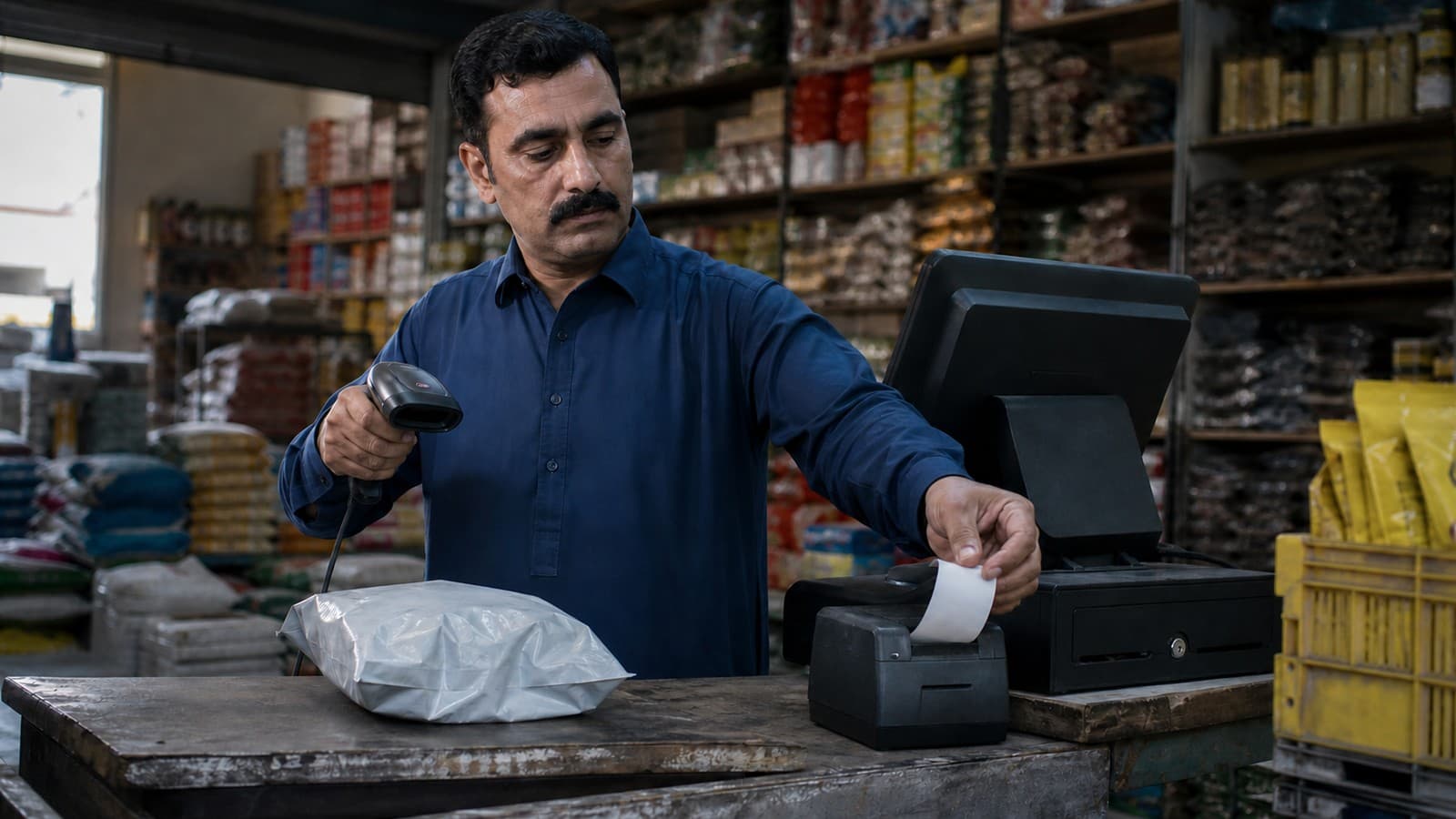
A counter that closes the day in minutes
Scan, bill, print, and the stock report updates itself. The till stops being a cash box with a screen.
- Barcodes and labels
- Stock and reorder reports
- Staff trained at handover
One counter, itemised
| Item | Typical PKR | Worth knowing |
|---|---|---|
| POS terminal | 48,000 – 95,000 | A touch terminal, or a desktop PC doing the identical job for less money |
| Thermal receipt printer | 14,000 – 28,000 | 80mm with auto-cut. The hardest-working box on the counter — economise elsewhere |
| Barcode scanner | 7,000 – 20,000 | Wired for a fixed till; wireless if the same gun audits shelves |
| Cash drawer | 9,000 – 16,000 | Fired by the printer on every sale, so it only opens against a receipt |
| Customer display | 10,000 – 22,000 | Shows each line as it scans; disputes at the till drop off sharply |
| Label printer | 20,000 – 38,000 | Needed only where loose or local stock has to carry your own barcodes |
| Billing & inventory software | one-time or monthly | A packaged product where it fits your trade; ours where nothing does |
A complete working counter — terminal, printer, scanner, drawer and software — typically lands between PKR 90,000 and 160,000 installed in Islamabad and Rawalpindi. Pharmacies running batch and expiry tracking sit at the top of that band. Every row above is its own line on our quotation, so you can start without the customer display or label printer and add either later, instead of financing the full table on day one.
Hardware is an afternoon. Stock is the week.
Plenty of sellers in the twin cities will deliver these boxes and drive off. Whether the system survives is decided in the days after: your real items, at your real prices, entered into the software while the shop keeps trading. We sit through that first stock count with you, set up label printing for the loose goods, wire the drawer to fire from the printer, and close the first day together so the drawer and the report agree from the start.
Pharmacies get batch numbers and expiry dates switched on from the very first entry. Bolting them on after six months of loose data is a job that never actually happens — a little more typing in week one is what makes the expiry report true in month twelve.
Three things the software must do here
Bill with the internet down
An outage or a cut fiber cannot be allowed to close the till. Billing runs on the counter itself and syncs when the line returns — anything that goes blank without a connection has no business in a busy mart.
Keep stock honest
Received, sold and on-shelf must agree, and when they stop agreeing the report should say so that evening. In a mart with staff on the floor, a same-day variance report is the polite name for shrinkage control.
Export for the accountant
Day-end summaries in the format your accountant already imports, produced in one click. The till exists to settle arguments — it should never start one with your bookkeeper at tax time.
Point-of-sale questions
Does billing stop when the internet does?
Not on a properly built counter. The software bills locally and syncs once the connection is back, so a cut fiber or a dead router never freezes the till. Cloud-only systems that go blank without internet are the thing we are most often called to rip out and replace.
Can it feed the software my accountant already uses?
Almost always. Daily sales and stock movement export in formats the common accounting packages import, so your accountant keeps their tools and you keep your data. Where a trade needs something none of the packages do, we build it — that work lives on our software page.
How long until my staff can run it?
Scanning and billing take an afternoon. Receiving stock and closing the day take a few evenings with us on the phone. Training happens on your own stock during handover — never a demo database — and a printed quick-guide stays taped beside the till.
Half my stock has no barcodes. Now what?
That is the normal Islamabad mart: packaged goods arrive barcoded, loose and local items do not. We set up a label printer so you print your own codes, and we help with the first full stock count — which is the real work of going digital. The hardware is the easy part.